If you’ve ever tried on a dozen frames and felt like none of them looked quite right, your face shape, not your taste, might be the reason. Diamond faces have a few distinctive traits that some people keep in mind when choosing glasses.
This guide is designed to walk through general frame-shape considerations for diamond-shaped faces. We’ll break down how a diamond face shape works and how different frame styles are commonly paired with this face shape in style guides.
We’ll explore which glasses for diamond face shapes are commonly recommended in style guides, general factors people consider when choosing frame proportions, and how to think about fit.
By the end, you’ll have a general checklist of frame shapes, widths, and details you may want to consider as you shop online or in-store.
How to Tell if You Have a Diamond Face Shape
Before you choose frames, it helps to confirm that you do in fact have a diamond-shaped face. Stand in front of a mirror or take a straight-on selfie. Trace the outline of your face with your finger or a drawing app. If the broadest point is at your cheekbones and your forehead and jaw are noticeably narrower, you likely land in the diamond category.
It’s also useful to compare a few key features: Does your chin come to a gentle point? Are your cheekbones prominent from the side? Does your forehead feel relatively compact compared with your mid-face? These are all traits commonly mentioned when people talk about diamond face shapes.
Remember, no face fits a perfect diagram. Your face might share traits with oval or heart shapes too. Use the diamond-face guidelines as a reference point not a strict rulebook when choosing frames.
Glasses Styles for Diamond Faces
Once you’ve identified a diamond face shape, many style guides focus on “balance.” A commonly mentioned goal is to pair angular features with frames that add visual width at the browline.
Warby Parker’s own guide on Glasses for Diamond Face Shapes notes that styles with some width at the top of the frame and softer curves are often suggested.
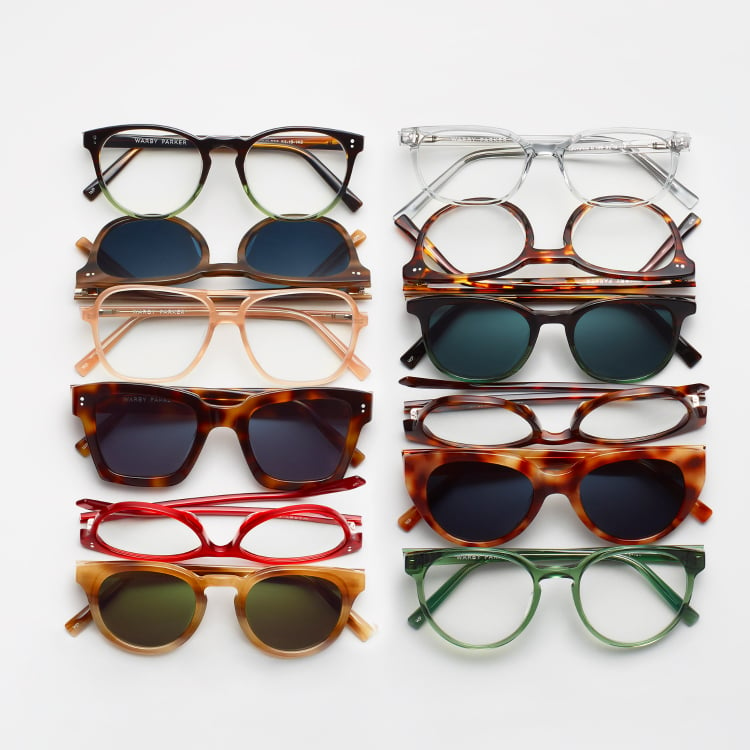
Rounded, oval, and softer geometric frames are frequently recommended. Many style guides note that these shapes can pair well with angular cheekbones and bring some contrast to sharper lines.
- Cat-eye frames: These have upswept corners and add emphasis near the upper part of the frame, which some people like to pair with a narrower forehead.
- Round and oval frames: These shapes introduce curves rather than angles, which some people prefer alongside more prominent cheekbones.
- Browline and semi-rimless: Emphasis at the top of the frame adds visual weight near the browline, which can create a different overall proportion compared with frames that emphasize the lower edge.
- Soft aviators: Lightly teardrop shapes with rounded edges are another option some people consider, especially if they’re not overly large or sharply angled.
Oval and round frames are frequently recommended for diamond faces, due to their mix of curves and structure. If you’re interested in this approach, you might focus on styles with slightly thicker or darker top rims rather than very heavy lower rims, which can shift more visual emphasis toward the lower part of the frame.
Frame Size, Width, and Details: Thinking About Fit
Even a frame style you like may feel different depending on its size. For diamond faces, frame width is one detail many guides highlight. If the frame is much wider, your face may appear narrower by comparison; if it’s much narrower, your cheekbones can stand out more.
Look for frames that extend just slightly beyond your temples without flaring out dramatically. The lenses should sit in a way that feels centered around your eyes, with your pupils roughly aligned near the horizontal middle of each lens. This can help keep the frame centered on your face and aligned with your eyes.
Details also play a role in how frames look on your face. Decorative or thicker browlines, subtle color gradients that are darker at the top, and gentle curves around the lenses all influence where attention goes when someone looks at your glasses. Very heavy lower rims or bold detailing along the bottom edge tend to draw more focus toward the lower part of the frame.
Comfort is another key consideration: Nose pads or bridge pieces should rest evenly without slipping, and the arms should sit along the sides of your head without pinching. A pair of glasses you like the look of should also feel comfortable for everyday wear.
Final Thoughts on Glasses for Diamond Face Shapes
When you’re looking at glasses for diamond face shapes, it can help to focus on frame shapes that echo strong cheekbones and consider how the frame interacts with a narrower forehead and jaw. Rounded, oval, cat-eye, and browline styles with gentle curves and a slightly emphasized top edge are often recommended in style guides, especially when their width is similar to your cheekbone width.
As you browse options, you might find it helpful to ask yourself questions like: How does this shape interact with my angles? Does the width of this frame sit close to the width of my cheekbones? Where do the frame details draw my eye when I look in the mirror? These kinds of questions can help you compare how different frames look to you.
You can use this guide as a general checklist the next time you shop. Try on a few different shapes side by side, experiment with various browline thicknesses, and notice how each pair changes the overall proportions you see in the mirror. When you find proportions you like, your frames will feel especially well matched to your face shape.
Legal Disclaimer
MEDICAL DISCLAIMER: This content is provided for educational and informational purposes only and is not intended as medical advice, diagnosis, or treatment. This information should not be used to replace professional medical care or consultation. Individual results may vary significantly. Always consult with a qualified healthcare provider before making any decisions about your health, vision, or medical treatment. Never disregard professional medical advice or delay seeking treatment because of information you have read on this website.
VISION CARE DISCLAIMER: Vision correction needs vary by individual. Consult an eye care professional for personalized assessment and recommendations.
FDA DISCLAIMER: These statements have not been evaluated by the Food and Drug Administration. This content is not intended to diagnose, treat, cure, or prevent any disease or medical condition.
PROFESSIONAL CONSULTATION REQUIRED: Only qualified eye care professionals can provide personalized recommendations for your specific vision needs and health conditions.
This article is for informational purposes only. It is not intended to provide medical advice or substitute for professional health services. Warby Parker complies with all HIPAA regulations regarding your health information. For personal health questions or concerns related to your vision or eyewear prescriptions, please consult a qualified healthcare provider.
What glasses shape is often recommended for a diamond face?
Cat-eye, oval, round, and browline frames are frequently mentioned in style guides for diamond face shapes. These styles typically add some visual emphasis near the browline and introduce curves or softer lines.
Should diamond-shaped faces wear round glasses?
Many people with diamond-shaped faces choose round glasses. Round frames introduce more curved lines, which some people find appealing alongside more angular or prominent cheekbones.
Are rectangular glasses an option for diamond faces?
Soft-edged rectangular frames can be an option if they aren’t too narrow or sharply boxy. Some people look for versions with slightly rounded corners and a width that’s similar to their cheekbones.
What might I want to avoid when choosing glasses for a diamond face?
Some people with diamond-shaped faces prefer to skip very narrow, very wide, or extremely boxy frames. Oversized square shapes and very heavy bottom rims can create a more angular, lower-heavy look, which not everyone prefers.
Do rimless glasses work with diamond face shapes?
Rimless and semi-rimless styles can also be paired with diamond face shapes. If you’re exploring this option, you might look for lenses that are oval or gently rounded and frames where the top edge provides a bit of visual structure.